Automatic Lift Carousel Warehouse Storage System Modula Storage Warehouse Picking
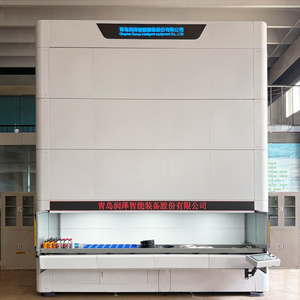
Microprocessor-guided vertical lift module (VLM) designed for rapid batch picking, dynamic tray management, and 85% floor footprint reclamation.
Engineered to satisfy FEM 10.2.02, EN 15512, and RMI standards. Every system incorporates finite element analysis (FEA) to maximize cubic storage volume while mitigating dynamic load deflection risks.
Microprocessor-guided vertical lift module (VLM) designed for rapid batch picking, dynamic tray management, and 85% floor footprint reclamation.
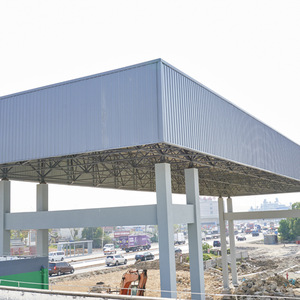
Heavy structural I-beam and cold-formed C/Z purlin platforms doubling industrial workspace for multi-tier fulfillment, assembly, and executive control hubs.
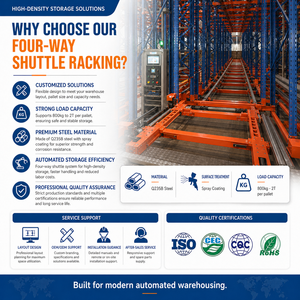
High-density multi-directional shuttle fleet designed for intense pallet turnover, cold storage down to -25°C, and fully lights-out automated fulfillment.
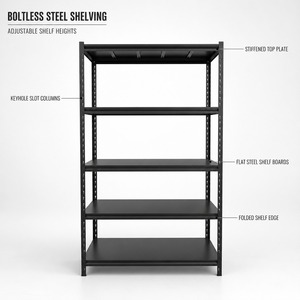
Interlocking rivet and butterfly clip modular racking for rapid, tool-free installation across maintenance depots, retail stockrooms, and e-commerce picking paths.
Specialized commercial hospitality display with structural acrylic tiers, RF-modulated LED telemetry, and IP-rated fluid-spill isolation for commercial retail.
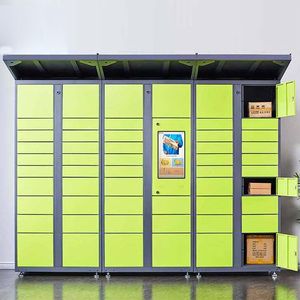
Heavy-gauge cold-rolled galvannealed steel smart lockers featuring biometrics, biometric 3D facial authentication, and anti-pry solenoid latch locking arrays.
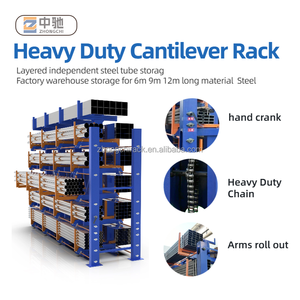
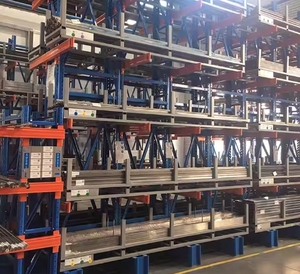
Heavy-duty structural column cantilever system engineered without front upright barriers, facilitating unobstructed overhead crane loading of extrusions and pipes.
Heavy-duty 5-layer convertible beam system with lateral support arms, optimized for storing structural timber, electrical conduit, and dense mechanical parts.
Industrial storage racking safety is governed by strict physics. Our manufacturing framework utilizes continuous cold-roll forming, automated robotic gas-shielded arc welding, and electrostatic polyester powder curing to resist ambient moisture, shear deflection, and accidental mast impacts.
| Racking Typology | Primary Structural Profile | Standard Load Envelope | Beam Deflection Ratio | Applicable Standards | Ideal Logistics Profile |
|---|---|---|---|---|---|
| Selective Pallet Racking | Omega-profile Upright + Box/Step Beam | 1,000 – 4,500 kg per pair of beams | L/200 standard (EN 15512) | FEM 10.2.02 / RMI | High SKU variety, 100% direct selectivity, FIFO |
| Drive-In / Drive-Through | Heavy C-Purlin cantilever guide rails | 1,000 – 1,800 kg per pallet lane | L/250 restricted flex | ISO 9001 / EN 15512 | Cold storage, uniform SKUs, batch manufacturing, LIFO |
| Automated 4-Way Shuttle AS/RS | Cold-rolled high-precision running rails | 500 – 1,500 kg dynamic payload | L/300 high-precision alignment | DIN EN 528 / CE / WMS | Deep lane buffering, 24/7 dark warehouse, high throughput |
| Heavy Structural Cantilever | Hot-rolled H-Beam column + pivot arms | 500 – 3,500 kg per tapered arm | L/180 cantilever moment | AISC / EN 1993-1-1 | Steel pipes, lumber bundles, timber, extrusions |
| Structural Multi-Tier Mezzanine | Universal Columns (UC) & Beams (UB) | 350 – 1,200 kg/m² uniform live load | L/300 flooring deflection | Eurocode 3 / OSHA | Archive records, duplex office, e-commerce packing hubs |
Modern supply chains no longer treat racking as inert ironwork. Modern racking acts as an integrated structural substrate for automated robotics, edge sensors, and dynamic intralogistics orchestration.
Legacy static warehouses are upgrading to multi-tier automated four-way shuttle grids. Precision steel rolling ensures millimeter-grade track alignment, allowing automated shuttles to transition smoothly between transverse aisles and vertical lifts with negligible friction loss.
With seismic engineering codes tightening globally, baseplate calculations now incorporate finite element anchor tension modeling. Racking footplates distribute dynamic overturning moments across floor slabs, preventing punching shear failure under high-bay configurations up to 40 meters.
Smart storage facilities are embedding wireless triaxial tilt and strain sensors directly onto bottom upright protectors. Instant alerts trigger via WMS dashboards if a forklift impact exceeds rated shear thresholds, allowing for targeted inspections before catastrophic structural failures can occur.
Procurement directors are shifting focus from purchase-price-per-ton to total cost of ownership (TCO), ESG compliance, and long-term modular reconfigurability.
Buyers avoid fixed single-use designs. Preferred systems feature teardrop or omega perforations with 50mm–75mm pitch adjustments, enabling rapid transitions from manual selective storage to carton-flow or automated shuttle operations without replacing main frames.
With European CBAM regulations and global net-zero targets advancing, corporate logistics procurement mandates Environmental Product Declarations (EPDs). Sourcing from electric arc furnace (EAF) mills using recycled scrap reduces embedded carbon by up to 60%.
Rising ocean freight costs make nesting geometry critical. Custom-bundled upright profiles and nested beam structures optimize 40ft High-Cube container volume, lowering landed unit logistics costs for cross-border projects across the Middle East, Africa, and the Americas.
Industrial developers increasingly select EPC-style manufacturers who provide structural calculation reports, stamped AutoCAD layouts, and specialized on-site rigging teams to safely commission and hand over projects to local building authorities.
Backed by decades of industrial manufacturing experience and serving distributors, 3PL giants, pharmaceutical cold chains, and retail logistics across the UAE, GCC, Africa, and worldwide, our engineering team balances cubic efficiency, forklift clearance, and strict seismic building codes.
We run continuous laser-guided punching lines and automated roll-forming machines. From calculating punching shear resistance on unreinforced floor slabs to designing double-deep reach aisles, our structural packages deliver certified performance and long-term durability.
Structured methodology ensuring zero tolerance discrepancy from raw coil to operational commissioning.
Laser measurements of usable clear heights, floor flatness ratings, column spacing, and dock accessibility.
Analysis of unit weights, pallet entry profiles, seismic zoning factors, and material handling equipment turning radii.
Detailed plan views, elevation schematics, structural calculation packages, and itemized bill-of-materials signoff.
High-precision cold-roll forming, automated robotic welding, multi-stage powder curing, and export bundling.
Anchor bolt torque verification, beam safety pin locking, plumbling tolerance signoff, and certified capacity signage.
Key technical considerations, standard compliance, and structural design factors addressed by our senior applications engineering team.
Floor suitability is verified by reviewing the slab thickness, concrete compressive strength (such as C25/30 or C30/37), subgrade modulus ($k$-value), and reinforcement bar configuration against the concentrated point load imparted by the rack baseplates. If point loads cause excessive punching shear stress, our engineers enlarge the baseplate footprint or install continuous load-distributing spreader channels beneath the upright frames.
Both specifications evaluate limit states, column buckling, and beam connection stiffness ($K_b$). However, EN 15512 incorporates higher partial safety factors on dead and live load combinations ($\gamma_G = 1.35$, $\gamma_Q = 1.5$) and requires physical load testing of physical beam end connectors to establish rotational spring characteristics, whereas RMI utilizes ASD/LRFD methods derived from AISI cold-formed steel standards.
Standard logistics operations allow a maximum vertical beam deflection of $L/200$, where $L$ is the clear distance between uprights (for example, 13.5mm deflection on a 2700mm beam under rated load). In semi-automated reach truck or high-bay AS/RS setups, deflections are restricted to $L/300$ or $L/350$ to avoid catching pallet skids or tripping automated laser guidance systems.
Per NFPA 13 and local civil defense guidelines, back-to-back rack rows require a continuous longitudinal flue space of at least 75mm (often maintained at 150mm), and transverse flue spaces of 75mm between adjacent pallets. These clear paths allow upward thermal airflow to trigger ceiling fire sprinklers rapidly, while in-rack sprinkler barrier pipes can be mounted along inner spacer beams.
Yes, provided the structural configuration matches certified load documentation. Altering beam tier levels changes the upright's unbraced column length ($L_{cr}$), which recalculates frame carrying capacity. Our engineering team provides recertification, professional teardown, safe logistics transport, anchor re-torquing, and replacement of any damaged upright components or shear pins.
Standard indoor powder coating is suitable for temperature-controlled warehouses. For coastal hubs with high relative humidity and airborne salinity (such as Gulf coastal regions), we apply heavy-duty hot-dip galvanizing (ISO 1461, 65–85μm zinc thickness) or specialized marine-grade epoxy-polyester powder coats to prevent rust bleed and premature steel fatigue.
Send your warehouse floor plans (DWG/PDF), clear working heights, unit pallet dimensions, and forklift technical specifications. We provide a complimentary CAD layout and structural load assessment within 24 hours.