Featured Industrial Racking & Specialized Logistics Systems
Engineered for extreme structural stability, high-bay clearance, and precision material handling. Directly supplied and exported globally with third-party metallurgy certification.
Architecting High-Density VNA Racking: Principles, Tolerances, and Physics
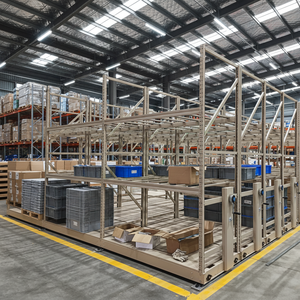
In the contemporary intralogistics landscape, escalating industrial land acquisition costs and skyrocketing warehousing operational expenses have fundamentally reshaped storage facility planning. Global supply chain directors, contract logistics (3PL) conglomerates, and regional cold-chain operators are aggressively abandoning conventional wide-aisle Adjustable Pallet Racking (APR) in favor of Very Narrow Aisle (VNA) Racking Systems. By shrinking operating aisle widths from standard dimensions of 3.2m–3.8m down to a condensed 1.5m–1.8m footprint, VNA configurations reclaim up to 45% to 50% of wasted circulation floor area while leveraging unexploited vertical clear heights up to 18.5 meters.
However, operating at heights exceeding 12 meters with specialized turret trucks or man-up order pickers creates extraordinary mechanical forces. Unlike low-bay systems where manufacturing variations can be absorbed by generous handling tolerances, a VNA racking installation operates under infinitesimal margins of error. A minute angular displacement of just 0.5 degrees at the baseplate manifests as a disastrous mast sway of over 150mm at the top tier. Consequently, sourcing VNA racking from premier Chinese manufacturing facilities is no longer a simple transactional purchase of cold-rolled steel; it is a structural engineering integration that encompasses floor slab micro-topography, cold-formed metallurgy, dynamic aisle guidance systems, and seismic mitigation engineering.
Comparative Structural & Volumetric Benchmark Matrix
Engineered evaluation of VNA against prevailing global industrial warehouse racking typologies.
| Storage System Typology | Aisle Clear Width (mm) | Max Operating Height (m) | Floor Footprint Utilization | SKU Selectivity Ratio | Handling Equipment Type | Required Floor Slab Class |
|---|---|---|---|---|---|---|
| Very Narrow Aisle (VNA) | 1,500 – 1,850 | Up to 18.5m | 90% – 95% | 100% Direct Access | Man-Up / Man-Down Turret Truck, VNA AGV | DIN 18202 Zeile 4 / TR34 DM1, DM2 |
| Standard Selective APR | 3,200 – 3,800 | Up to 11.5m | 40% – 50% | 100% Direct Access | Counterbalanced Forklift, Reach Truck | Free Movement FM3 / ASTM $F_F$ 25 |
| Double-Deep Pallet Rack | 3,000 – 3,400 | Up to 10.0m | 60% – 65% | 50% Direct (LIFO/FIFO) | Pantograph Reach Truck | Free Movement FM2 / ASTM $F_F$ 35 |
| Drive-In / Drive-Through | Lane Dependent | Up to 12.0m | 75% – 85% | Low (Bulk Batches) | Counterbalance / Reach Truck | Standard Industrial Slab |
| High-Bay AS/RS (Staker Cranes) | 1,350 – 1,600 | Up to 40.0m | 95% – 98% | 100% Automated | Automated Stacker Crane (SRM) | Superflat Concrete / Steel Baseplate Grillage |
Aisle Guidance Dynamics: Mechanical Low-Profile Steel Rails vs. Inductive Wire Guidance
Because clearance gaps between the forklift load profile and pallet beam faces are typically restricted to only 75mm–100mm on either side, manual steering inside a VNA aisle is strictly precluded. Turnkey engineering from top-tier Chinese manufacturers integrates one of two proven aisle guidance systems:
- Mechanical Low-Profile Steel Guide Rails: Utilizing continuously anchored inverted steel angles (typically $100\times 75\times 8\text{mm}$ or $125\times 75\times 10\text{mm}$ cold-formed angles) chemically grouted into the concrete slab via M12/M16 high-tensile anchors at 300mm–500mm centers. Hardened polyurethane side guide rollers installed on the turret truck make physical contact with the rail, physically locking the vehicle on a rigid center-line trajectory. High-impact flared entry lead-in shoes with heavy gusseting absorb lateral alignment shocks at aisle thresholds.
- Inductive Electromagnetic Wire Guidance: In modern high-throughput logistics hubs, wire guidance eliminates mechanical perimeter rails, preserving clear floor surface access and preventing tripping hazards. A high-frequency signal wire (operating between 5 kHz and 10 kHz) is embedded into a 4mm wide by 15mm deep precision diamond-sawn trench along the aisle centerline, sealed with flexible structural epoxy resins. Sensor antennae mounted at the front and rear of the turret truck detect electromagnetic phase differentials, dynamically steering the steer-drive motors with sub-millimeter precision.
Superflat Slab Engineering: Navigating DIN 18202, TR34, and ASTM E1155
A critical information-gain reality that tier-1 engineering whitepapers must highlight: the performance of a VNA system is irrevocably tethered to concrete floor slab micro-flatness. International racking failures or truck de-rating cases rarely stem from beam steel failure; they stem from static slab un-levelness amplified dynamically through vertical mast extensions. In accordance with the Concrete Society’s TR34 (4th Edition) Defined Movement (DM) specifications:
- DM1 Classification: Mandatory for VNA installations with top beam levels exceeding 13.0 meters. Permissible elevation cross-aisle difference ($Z_{slope}$) between vehicle wheel centers cannot exceed 1.5mm/m.
- DM2 Classification: Applicable for VNA installations with top beam elevations operating between 8.0m and 13.0m.
- DIN 18202 Table 3 Line 4: The strict German tolerance requiring elevated surface profiling to prevent resonant vehicle oscillations under full 1,500kg nominal dynamic hoist loads.
Premier Chinese manufacturers bridge this divide by deploying digital optical leveling surveys, delivering customized extra-wide shim leveling packs ($100\times 120\text{mm}$ to $140\times 160\text{mm}$) with precision non-shrink structural underplate grouting to ensure column plumbness meets or exceeds 1:1000 verticality tolerances.
Why Global Procurement Directors Choose Chinese VNA Manufacturers
Uncompromising structural steel chemistry, fully automated continuous roll-forming lines, and certified quality management aligned with FEM and ANSI criteria.
Direct Rolling-Mill Metallurgy
Direct supply contracts with sovereign steel giants (Baosteel, Shougang) guarantee high-tensile Q235B and Q355B (yield strength $f_y \ge 355\text{ MPa}$) certified steel with verified chemical mill test certs (MTCs).
Continuous CNC Laser Punching
Multi-stage automated cold-roll-forming profiles uprights up to 14 meters continuous length without splice joints, maintaining continuous pitch punching tolerances under $\pm 0.1\text{mm}$ for 100% beam interchangeability.
EN 15512 & FEM Standards
Full engineering validation conforming to European Standard EN 15512:2020, FEM 10.2.02, and American RMI MH16.1. Comprehensive destructive testing validates connection stiffness ($C_i$) and upright stub-column buckling capacity.
Worldwide Turnkey Export
Dedicated export crating engineering maximizing 40HQ container volumetric capacity, paired with pre-drilled components, bilingual load plaques, and dispatch of international installation supervisors across GCC, MEA, Europe, and the Americas.
Future Procurement Trends & Technological Innovations
How digital automation, autonomous guided vehicles, and carbon-neutral logistics are shaping high-density warehouse storage procurement.
Converged VNA + Autonomous Mobile Robots (AMRs)
Traditional manually steered turret trucks are rapidly yielding to driverless high-lift hybrid VNA-AMRs. Sourcing specifications now mandate optical target reflectors embedded on uprights and millimeter-accurate clearance profiles to facilitate 24/7 automated lights-out order picking.
Integrated IoT Structural Health Monitoring
Modern VNA tenders increasingly require factory-integrated strain sensors and optical deflection monitors embedded along critical upright columns and seismic top ties. Real-time telemetry detects forklift impact stresses, structural loading shifts, and thermal expansion in sub-zero environments.
Thermal Isolation in Deep-Freeze VNA
With cold-chain pharmaceutical and food logistics expanding globally, VNA installations inside -30°C automated vaults demand specialized micro-alloyed steels with verified Charpy V-notch impact toughness at low temperatures, combined with polyamide baseplate thermal break pads.
Low-Embodied Carbon & Thin-Gauge Ultra-High Yield
Global multi-national tenders require verified Environmental Product Declarations (EPDs). Chinese manufacturers lead in deploying cold-rolled ultra-high-strength steel grades ($f_y \ge 450\text{–}550\text{ MPa}$), reducing overall steel mass by 14% while retaining identical deflection limits ($L/200$).
From Warehouse Spatial Scan to Handover: The 5-Stage Workflow
A transparent, data-driven execution framework engineered to eliminate procurement surprises, lead-time slippage, and structural commissioning snags.
Structural Audit
Evaluation of architectural drawings, column grid pitches, overhead MEP clearance, dock access, and floor slab flatness specifications.
Finite Element CAD
3D beam modeling, wind/seismic simulation according to local building codes, dynamic flue space design, and detailed pallet throughput simulation.
Precision Roll-Forming
Automated manufacturing, shot-blasting surface pre-treatment (Sa 2.5), and thermoset polyester-epoxy electrostatic powder coating (60–80μm).
Export Crating
Bundle wrapping with specialized corner steel protectors, vapor-phase corrosion inhibitor (VCI) films, and optimal container cube balancing.
Laser Align & Handover
Optical laser alignment, torque anchoring audits, beam safety lock verification, installation of rated load capacity plaques, and CE documentation.
Frequently Asked Questions by Global Logistics Engineers
Definitive answers covering floor slab remediation, load deflection equations, seismic bracing criteria, and international export logistics.
What is the maximum permissible beam deflection in a certified VNA racking bay?
Under both EN 15512:2020 and RMI MH16.1 specifications, the maximum allowable vertical deflection ($\delta$) for a horizontal pallet support beam under full uniformly distributed load (UDL) cannot exceed $\delta = L / 200$ (where $L$ is the clear beam length between upright faces). However, in high-reach automated VNA or robotic turret environments where masts exceed 14 meters, tier-1 engineering specs frequently dictate an even stricter deflection criteria of $\delta = L / 300$ or a maximum of 10mm absolute deflection to prevent automated turret extraction sensors from faulting during dynamic load deposit cycles.
How are existing warehouse slabs upgraded if they fail DIN 18202 / TR34 DM1 flatness?
If a brownfield facility slab fails to meet the tight angular elevation limits required for VNA turret trucks, floor remediation is executed prior to rack erection. The two industry-standard methodologies are Precision Laser Grinding (using automated robotic dry-diamond planers traversing the dedicated turret wheel paths to carve down high spots to DM1/DM2 specifications) and Self-Leveling Polymer Underlayment Screeding with high-compressive-strength cementitious epoxies capable of resisting localized wheel point loads exceeding 8.0 MPa.
Why is top-tie bracing structural bridging required in VNA configurations?
Because VNA racks possess height-to-depth ($H:D$) aspect ratios frequently exceeding 10:1 (for example, a 15-meter tall upright frame sitting on an 1,100mm deep base), the system is vulnerable to lateral frame buckling and harmonic swaying induced by high-level mast deceleration. Overhead structural top ties (box sections or structural channels spanning across the clear aisle to interlink adjacent double runs) transfer horizontal sway forces across the entire structural grid, vastly enhancing system rigidity and seismic damping without impeding forklift mast travel.
How does container packing design prevent transit corrosion and warping during ocean freight?
Leading Chinese exporters package cold-formed structural steel members into heavy welded sub-frames fitted with heavy-gauge corrugated dunnage and high-density polyethylene edge protectors. Individual bundles are wrapped in industrial-grade heat-shrink film injected with Vapor-phase Corrosion Inhibitor (VCI) tablets to prevent oxidation during 30–45 day maritime crossings through high-humidity equatorial trade routes. Upright column nested spacing is customized via CAD container nesting software to achieve up to 26–27 metric tons per 40ft HQ container without exceeding shipping weight limitations.
Accelerate Your High-Density Intralogistics Transformation
Collaborate directly with our senior structural racking engineers. Submit your warehouse architectural CAD layout, ceiling clear height, pallet loading profiles, and reach truck parameters to receive a complimentary 3D layout rendering, capacity calculation sheet, and comprehensive DDP/FOB procurement proposal within 48 hours.