Multi-Tier Mezzanine
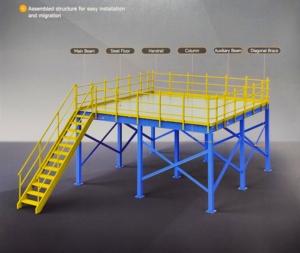
Explore our precision-fabricated heavy-duty warehouse racking systems, modular mezzanines, automated retrieval infrastructures, and specialized industrial coil handlers designed for extreme load environments.
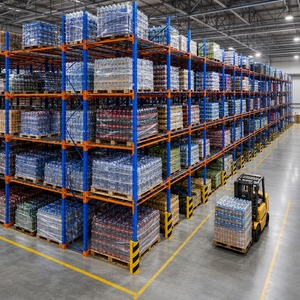
B2B warehouse operations cannot rely on catalog estimates. Heavy-duty pallet racks represent life-safety critical structures governed by elastoplastic beam deflection limits, second-order $P-\Delta$ seismic effects, and strict metallurgical chemistry.
Our upright extrusions utilize prime-grade structural steels Q235B and Q355B (equivalent to ASTM A36 and ASTM A572 Grade 50 / European S355JR). Every coil batch undergoes carbon equivalency testing ($CEV \le 0.42\%$) and spectrometry to ensure superior weldability, notch toughness at sub-zero cold-storage temperatures ($-30^\circ\text{C}$), and guaranteed yield strengths up to 355 MPa without micro-fissuring.
We deploy 24-station automated rolling mills that incrementally shape high-tensile steel strip into multi-bend omega ($\Omega$) profile uprights. Multi-bend geometries introduce localized cold work hardening that increases critical local buckling stress by up to 28% compared to conventional C-sections. Computer-controlled punch tooling guarantees hole-pitch accuracy of $\pm0.15\text{mm}$ across a 12-meter span.
Industrial racking operating in harsh Middle Eastern, equatorial African, or chemical storage environments requires exceptional surface barrier protection. Our electrostatic thermosetting polyester powder coating line features a multi-stage zirconium phosphating pre-wash, yielding 80–120 micron dry film thickness (DFT) that withstands 1,000+ hours of ASTM B117 salt spray testing.
Technical specifications evaluated in compliance with FEM 10.2.02, EN 15512:2020, and RMI MH16.1 guidelines.
| Storage System Type | Floor Utilization (%) | Selectivity Profile | Standard Bay Load (kg) | Optimal Lift Equipment | Seismic & Impact Rating |
|---|---|---|---|---|---|
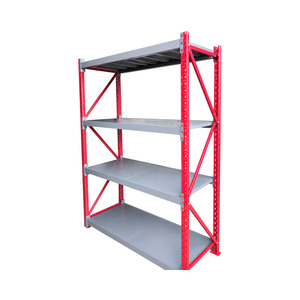
| Selective Pallet Racking (APR) | 35% – 40% | 100% Direct Access | 1,000 – 4,500 kg / level | Counterbalance / Reach Truck | FEM Class 400 (Standard) |
| Double-Deep Pallet Racks | 50% – 60% | 50% FILO Access | 1,500 – 3,500 kg / level | Pantograph / Deep Reach | Reinforced Base Anchorage |
| Drive-In / Drive-Through | 65% – 75% | High Density (LIFO/FIFO) | 1,000 – 2,000 kg / pallet | Standard Reach / Guided Truck | Dynamic Top-Tie Portal Bracing |
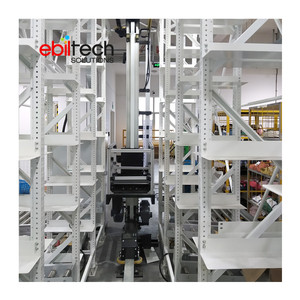
| Automated AS/RS (Miniload / Pallet) | 85% – 95% | 100% Automated Instant | 300 kg (Bin) – 2,000 kg (Unit) | Automated Stacker Crane / Shuttle | Ultra-Precision Mill Tolerances |
| Heavy Duty Cantilever Racks | 45% – 55% | 100% Clear Span | 1,000 – 6,000 kg / arm | Side Loader / 4-Way Truck | Engineered Tapered Arm Moments |
Unlike trading houses that resell lightweight catalog configurations, we engineer heavy-duty pallet rack systems tailored to the exact slab structural specifications, seismic acceleration coefficients ($S_s, S_1$), and forklift turning radii of our clients.
Prior to stamping manufacturing shop drawings, our structural engineers verify six mandatory technical variables:
Enterprise supply chain procurement is transforming rapidly under the combined pressures of automated intralogistics, ESG sustainability compliance, high-bay real estate costs, and regional trade shifts.
Traditional wide-aisle storage is rapidly converting into high-density AMR-accessible grid storage. Future procurement requires hybrid racking uprights featuring base-level sensor notches, magnetic track guide channels, and high-frequency pallet drop tolerances of $\pm2\text{mm}$. Buyers are prioritizing OEM suppliers capable of engineering floor-level robotic pick tunnels integrated beneath multi-tier pallet racks.
Global Fortune 500 distributors and mega-3PLs are embedding Environmental Product Declarations (EPD) into procurement tenders. High-tensile, low-alloy (HSLA) micro-alloyed steels enable a 14% to 22% reduction in total steel tonnage per pallet position while maintaining structural rigidity. OEM partners with electric arc furnace (EAF) scrap-recycled steel sourcing provide immediate Scope 3 emissions reductions.
Next-generation mega-distribution fulfillment centers are transitioning from annual visual inspections to continuous structural health monitoring (SHM). Enterprise RFPs now specify sensor-ready rack uprights retrofitted with wireless strain gauges and 3-axis accelerometer impact sensors that log forklift collision kinetic energy in real time, alerting WMS systems to structural displacement.
With pharmaceutical cold chains and blast freezing logistics expanding globally, racking metallurgy must resist low-temperature embrittlement without fracture. The market is shifting heavily toward batch hot-dip galvanized (HDG) steel components complying with ISO 1461, eliminating micro-chipping associated with powder paint during minus 30-degree deep-freeze pallet handling.
Skyrocketing land acquisition costs are driving facilities above 30 to 45 meters in clear ceiling height. In clad-rack systems, the heavy-duty racking uprights themselves form the structural skeleton that supports building wall cladding and roof loads. This eliminates secondary structural steel building columns, saving up to 25% on total civil construction Capex.
Supply chain volatility requires that physical storage racks can be reconfigured within days rather than weeks. Standardized teardrop or universal multi-slot punchings with bolting-free drop-in step beams enable swift transformation of standard selective bays into carton live flow, garment hanging (GOH), or heavy industrial shelving modules without welding or structural cutting.
Structural reliability is non-negotiable when millions of dollars in inventory and team member safety are hanging overhead. Here is how our OEM manufacturing and field engineering ecosystem protects your investment.
Every bay profile is modeled in Tekla and AutoCAD to millimeter precision. We coordinate directly with sprinkler engineers and material handling suppliers to prevent clash errors prior to roll-forming.
Robotic MIG welding stations ensure deep-penetration weld fillets across all beam-end connector plates. 100% visual inspection and batch ultrasonic non-destructive testing (NDT) are standard quality gates.
Export steel components are bundled with protective edge guards, vapor corrosion inhibitor (VCI) shrink wrap, and heavy timber dunnage engineered for containerized ocean transport without rack deformation.
Our installation teams install to approved structural drawings: torqued to specific anchor bolt ratings, leveled with steel shims, plumbed within FEM tolerances, and handed over with rated load capacity signage.
Comprehensive technical guidance addressing load calculations, seismic certifications, metallurgical differences, and OEM custom tooling parameters for international buyers.
Whether you require a full turnkey warehouse CAD capacity layout, bespoke OEM roll-formed components, or high-tensile structural calculations for global supply, our senior structural engineers are ready to assist with rapid BOM turnaround.