Engineered Cantilever Storage Solutions
Custom structural I-beam and roll-formed cantilever racks designed for non-standard, linear, and high-density material handling in demanding operating environments.
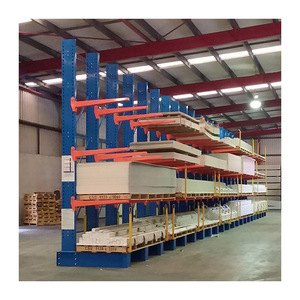
Mracking Adjustable Corrosion Protection Steel Pipe Storage Shelf System
- Upright Section: IPE 180 to 400
- Arm Load Capacity: 300 - 1500 kg/arm
- Finish: Duplex Epoxy Powder Coating
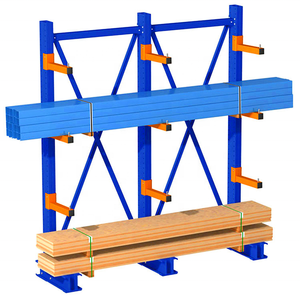
Industrial Steel Cantilever Racking for Pipe & Lumber Storage 500kg/arm
- Structural Pitch: 100mm Adjustable
- Configuration: Single or Double Sided
- Application: Heavy Timber & PVC Packs
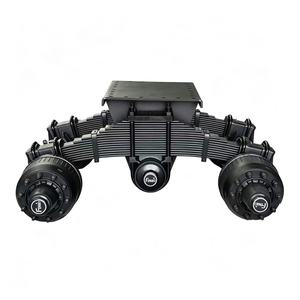
High Strength 24T-32T Heavy Duty Cantilever Mining Suspension System
- Load Rating: 24,000 to 32,000 kg
- Steel Grade: Cast Steel ZG270-500
- Application: Heavy Mining Dumpers
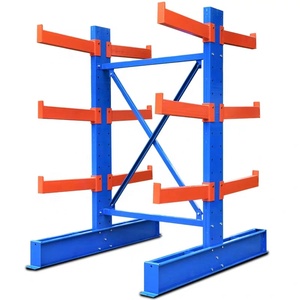
Industry Double Sided Heavy Duty Cantilever Rack for Structural Tubes
- Bay Load: Up to 18,000 kg total
- Upright Height: 2,500 - 9,000 mm
- Arm Incline: 2° to 4° anti-roll pitch
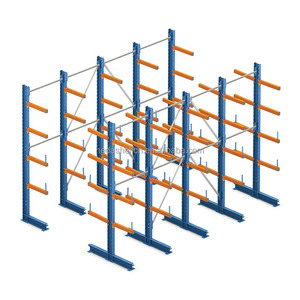
Hot-Dip Galvanized Outdoor Heavy Duty Cantilever Racks for Lumber Yards
- Coating: ISO 1461 Galvanized (85µm)
- Design: External Yard Cantilever + Canopies
- Life Cycle: 25+ Years Maintenance Free
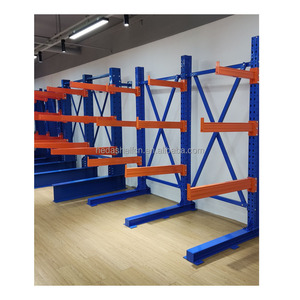
Single Sided Wall-Mounted Structural Profile Cantilever Racks
- Orientation: Perimeter Wall Flush Mount
- Arm Length: 600 - 1800 mm Reach
- Safety: Removable Front Stop Pins
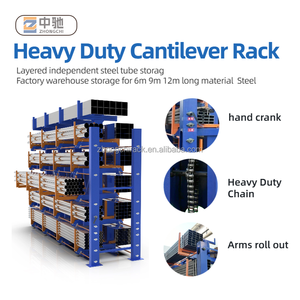
Double Sided High-Bay Cantilever Rack System for Steel Bar & Hollow Tubes
- Loading Class: Heavy Industrial Class 4
- Bracing: X-Braced Heavy Gussets
- Aisle Compatibility: Guided VNA / Side-Loader
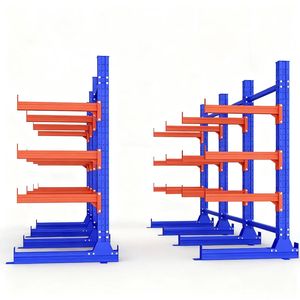
Mracking Heavy Duty Adjustable Cantilever Shelf for Extrusions & Sheet Packs
- Deck Options: Wire Mesh, Timber or Solid Steel
- Bolt Grade: High-Tensile 8.8 / 10.9 Fasteners
- Testing: Non-Destructive Weld Verification
Engineering Principles of Heavy Duty Cantilever Racking
A rigorous examination of section modulus selection, plastic deformation thresholds, moment connections, and deflection criteria in heavy-duty long goods warehousing.
Modern industrial supply chains handling non-palletized or awkward freight—such as structural steel beams, extruded aluminum profiles, copper piping, engineered lumber, and building facade cladding—face unique mechanical challenges. Conventional selective pallet racking systems utilize front vertical columns that obstruct continuous lateral horizontal planes, rendering long products un-storable without high risk of structural deflection or forklift collision. CE Certified Heavy Duty Cantilever Racking Systems provide an open, uninterrupted linear storage face by anchoring horizontal cantilevered arms directly to central, moment-resisting vertical columns.
1. Structural Steel Metallurgy: Hot-Rolled IPE Profiles vs. Cold Roll-Formed Profiles
A primary factor determining structural safety in high-capacity storage is the metallurgy and formation method of the vertical column and load-bearing arms. Engineering assessments require a strict distinction between cold roll-formed sheet steel profiles and hot-rolled structural steel sections:
- Cold Roll-Formed Steel Profiles: Suitable for light-to-medium industrial duty (under 400 kg per arm). Formed from cold-coiled steel strips passing through sequential rollers at ambient temperatures. While cost-effective, cold-formed sections exhibit residual manufacturing stresses, reduced ductility, and a susceptibility to local torsional-flexural buckling under concentrated point impact from heavy material-handling equipment (MHE).
- Hot-Rolled Structural Steel Sections (IPE, HEA, HEB): Engineered for severe industrial duties (500 kg to 5,000+ kg per arm). Fabricated from certified hot-rolled structural shapes (grades Q355B, S355JR conforming to EN 10025-2). Hot-rolled beams have thick flanges, superior section modulus properties, uniform isotropic tensile strength, and high impact resistance against MHE lateral collisions. Under extreme overload scenarios, hot-rolled steel undergoes predictable plastic yielding rather than the sudden catastrophic buckling typical of thin-gauge cold profiles.
2. Mechanical Moment Connection and Arm Attachment Mechanics
Cantilever arms act as pure structural cantilevers under distributed downward loads ($q$), producing maximum bending moment ($M = \frac{q \cdot L^2}{2}$) precisely at the junction where the arm connects to the column flange. To manage these immense concentration stresses, two primary mechanical connection interfaces exist:
- Articulated Pin-Jointed / Pivoting Connection: The arm is mounted via a high-tensile steel shear pin (grade 8.8 or 10.9) through precision-machined vertical brackets. If struck from below or horizontally by a forklift mast or suspended bundle, the arm pivots upward or slightly swivels without shearing the column connection or causing plastic deformation of the main upright.
- Rigid High-Tensile Bolted Flange Plate: The arm features a precision laser-cut base plate, bolted directly to the column face utilizing multiple pre-tensioned Grade 10.9 structural bolts. This configuration provides absolute positional rigidity and maximum continuous weight capacity, necessary in automated narrow-aisle (VNA) or high-bay stacker crane operations where zero arm movement is strictly mandated.
3. Vertical Column Deflection and Base Anchor Shear Dynamics
In accordance with the European Federation of Materials Handling standard FEM 10.2.09 (The Design of Cantilever Racking), cantilever columns undergo both axial compression and high un-symmetric bending moments, especially on single-sided systems or double-sided systems subject to asymmetrical loading. The permissible deflection limit for the cantilever arm tip is rigorously constrained to $L/200$ under full safe working load (SWL), where $L$ represents the clear arm length.
The base column connection utilizes a heavy gusseted foot welded directly to the upright column beam. Anchoring directly into the warehouse concrete slab requires calculated shear and pull-out verification. Chemical capsule anchors or mechanical undercut anchor bolts transfer high uplift tensile forces into the slab. A minimum reinforced concrete slab thickness of 200 mm to 300 mm (compressive strength grade C25/30 or C30/37) is mandatory to prevent concrete breakout cones under maximum bay overturn moments.
| Structural Parameter | Light / Medium Duty Series | Heavy Duty Structural Series | Extra-Heavy Yard System |
|---|---|---|---|
| Primary Steel Grade | Q235B Cold-Formed Steel | Q355B / S355JR Hot-Rolled IPE | S355J2 Hot-Rolled HEA/HEB |
| Column Upright Profiles | C-Section Profile 200-300mm | IPE 200, 240, 270, 300, 360 | HEA 240 to HEB 400 Profiles |
| Safe Working Load (SWL/Arm) | 150 kg – 450 kg | 500 kg – 1,800 kg | 2,000 kg – 5,000 kg+ |
| Standard Upright Heights | 2,000 mm – 4,500 mm | 3,000 mm – 9,000 mm | Up to 15,000 mm (High-Bay) |
| Arm Adjustment Pitch | 50 mm / 75 mm | 100 mm / 140 mm (Bolted) | 100 mm / 150 mm Fixed Pitch |
| Finish Options | Electrostatic Powder (60µm) | Duplex Epoxy-Polyester (80µm) | Hot-Dip Galvanized ISO 1461 (85-110µm) |
| Applicable Design Codes | EN 15620 / FEM 10.2.02 | FEM 10.2.09 / EN 15512 | EN 1993-1-1 (Eurocode 3) / EN 1090 |
Engineering Rigour Behind Every Installation
Eliminating operational risk through certified structural integrity, advanced automation manufacturing, and lifecycle compliance management.
Calculated Capacity Engineering
Every cantilever bay is structurally analyzed through Finite Element Analysis (FEA) software. We calculate point loads, uniform distributed loads (UDL), and torsional deflection using your actual goods data.
Automated CNC Multi-Axis Production
Manufacturing utilizes continuous CNC beam lines, precision robotic laser profile cutters, and automated submerged-arc welding machines to ensure dimensional tolerance consistency across large multi-tier runs.
Full CE EN 1090-1 Traceability
All delivered steel carries EN 10204 Type 3.1 mill test certificates, CE conformity declarations (Execution Class EXC2/EXC3), non-destructive testing reports, and ISO 9001 factory production control documentation.
Certified Global EPC Installation
From initial slab core inspection and laser-guided leveling to chemical anchoring, torque verification, and statutory load signage, factory-trained erection crews ensure strict compliance with regional health and safety mandates.
Emerging Trends in Cantilever Storage & Material Handling
How automation, smart sensors, and green metallurgy are restructuring the heavy goods procurement landscape over the next decade.
ASRS-Compatible High-Bay Cantilevers
The manual handling of long extrusions and sheet bundles is transitioning to automated stacker cranes and telescopic satellite carriages. Modern cantilever designs incorporate tight structural tolerances (sub-millimeter deflection tolerances under load) to interface seamlessly with laser-guided automated retrieval arms and robotic overhead gantries up to 25 meters in height.
Strain-Gauge Structural Health Monitoring
Real-time telemetry is entering heavy warehousing. Upright bases and critical moment arm connections are increasingly fitted with wireless strain gauges and micro-tilt sensors. These smart sensors log dynamic MHE impacts, register structural fatigue, and issue automated maintenance alerts before micro-fractures compromise column equilibrium.
Duplex Anti-Corrosion Systems for Outdoor Yards
External lumber and steel pipe storage yards in coastal or chemically aggressive regions are moving away from traditional single-coat wet paints. Procurement directives now specify hot-dip galvanizing per ISO 1461 combined with an electrostatic architectural polyester powder overcoat (Duplex System), delivering 40+ years of maintenance-free operation in C4/C5 marine environments.
Frequently Asked Questions by Industrial Engineers
Essential technical, regulatory, and mechanical criteria addressed by our structural application engineers.
How do you calculate the correct cantilever arm length and pitch?
Arm length must match or slightly exceed the depth of the load package (or diameter of stored pipe bundles) to prevent load overhang beyond the front arm tip, which creates an uncalculated eccentric torsion. The vertical pitch is determined by adding the load bundle height, required forklift lifting clearance (typically 100 mm minimum), and the cross-sectional depth of the cantilever arm itself.
What is the functional difference between single-sided and double-sided racks?
A single-sided cantilever is placed along building perimeter walls and experiences permanent eccentric forward overturning moments, requiring substantial base anchorage depth. Double-sided racks feature arms extended from both sides of the central column; when symmetrically loaded, the bending moments counteract each other, resulting in a balanced, highly stable structure with higher volumetric capacity per square meter.
Why is an upward arm incline angle (2° to 4°) standard on heavy cantilever arms?
When an arm is loaded to its certified SWL, steel undergoes elastic deflection. An upward pre-camber or slope of 2° to 4° compensates for this deflection, ensuring that under maximum load the arm settles close to horizontal rather than sloping downwards, which prevents cylindrical items (like steel tubes) from rolling off the arm face.
What warehouse slab thickness is required to support heavy cantilever uprights?
Because cantilever bases transfer high point-load compression and tension couples directly to the floor, non-shrink grout and heavy anchor bolts must be embedded into reinforced industrial concrete slabs with a typical minimum thickness of 200 mm to 300 mm. Prior to installation, a certified geotechnical slab core drill test is conducted to verify slab compressive strength ($f'c \ge 25 \text{ MPa}$) and reinforcement layout.
What is the standard inspection frequency under EN 15635 regulations?
Under EN 15635 guidelines for the application and maintenance of storage equipment, warehouses must maintain visual checks weekly or monthly by the internal PRSES (Person Responsible for Storage Equipment Safety), paired with a comprehensive formal technical inspection conducted by an independent certified inspector at intervals not exceeding 12 months.
Can cantilever racks be fitted with decking to store non-standard pallets?
Yes. Heavy-duty cantilever arms can be interconnected with structural steel cross-beams, open wire mesh decking, heavy timber bolsters, or continuous steel plates. This allows users to store variable-length items and standard pallets interchangeably across the same rack aisle without altering structural arm spacing.