Serving UAE, GCC & Africa Design · Supply · Installation · Relocation
Industrial Engineering Standard · FEM 10.2.02 & RPS 2000

Steel Pallet Racks Manufacturers & Exporter serving the Morocco Market

Precision-engineered, heavy-duty warehouse storage architectures, cantilever shelving, and automated high-bay racking systems tailored to Moroccan manufacturing hubs, free zones, and transshipment corridors.

100%
RPS 2000 Seismic Compliance
5,000 kg
Max Beam Load Capacity
Q235B / Q355B
Certified Structural Steel Grade
C3 - C5
Corrosion Resistance Rating
Export Portfolio for Morocco

Industrial Storage Systems Engineered for Moroccan Logistics Hubs

From the high-throughput automotive supply chains in Tangier Automotive City (TAC) and Kenitra Atlantic Free Zone to cold storage distribution centers across Casablanca and Agadir, our load-tested structural storage assemblies maximize volumetric density while complying with rigorous international safety protocols.

Economic Alignment & Nearshoring Dynamics

Why High-Bay Steel Racking Is Critical to Morocco's Industrial Expansion

The Kingdom of Morocco has rapidly transformed into North Africa’s premier trade gateway and industrial manufacturing platform, anchored by strategic state initiatives like the National Industrial Acceleration Plan (PAI) and the continuous development of port infrastructures such as Tanger Med, the largest container port on the Mediterranean and African continent. As European nearshoring accelerates, multi-national manufacturers and local logistics service providers face surging demand for vertical warehouse optimization.

Industrial land prices in key export corridors—including the Grand Casablanca-Settat industrial belt, the Tanger-Tétouan-Al Hoceïma region, and the Rabat-Salé-Kénitra zone—have made flat horizontal warehousing economically unfeasible. Modern facilities require high-density, multi-tier steel pallet racking systems capable of exploiting vertical clear heights up to 14 meters while adhering strictly to local seismic zoning criteria and marine coastal atmospheric parameters.

Automotive Ecosystem

Over 250 international suppliers operating in Tanger Automotive City and Kenitra Atlantic Free Zone require specialized coil racks, cantilever structures, and selective racking for sequenced just-in-time (JIT) deliveries to Renault Tanger and Stellantis.

Agro-Food Cold Storage

The Souss-Massa agricultural basin centered in Agadir and the Gharb plains export millions of tons of citrus, berries, and vegetables annually. These operations mandate galvanized drive-in and radio-shuttle pallet racks configured for sub-zero (-25°C) environments.

Phosphate & Chemicals

Managed by state giants like OCP Group in Jorf Lasfar and Safi, non-standard bulk chemicals, industrial parts, and slurry piping require reinforced cantilever and custom heavy steel cradle platforms designed for harsh corrosive agents.

FMCG & Retail E-Commerce

Modern distribution hubs in Casablanca (Ain Sebaâ, Sidi Maârouf, Bouskoura) supporting domestic retail chains and cross-border ecommerce rely on versatile selective pallet racking and multi-tier mezzanine floors to manage dense SKUs.

Structural Engineering White Paper

Engineering Integrity: Navigating Morocco's Seismic & Coastal Realities

Unlike standard off-the-shelf shelving, our warehouse racking systems exported to Morocco undergo exhaustive structural modeling based on the Finite Element Method (FEM) and European Standards adapted to Moroccan statutory mandates.

1. Seismic Design Under RPS 2000 (Règlement de Construction Parasismique) & EN 16681

Morocco exhibits distinct seismic risk zones. The northern corridor (Al Hoceïma, Nador, Tétouan, and Tangier) falls under Seismic Zone 3 and Zone 4, while Casablanca, Rabat, and central regions are located in Zone 1 to Zone 2. When racking structures reach heights of 8 to 14 meters and support hundreds of tons of dynamic inventory, horizontal seismic accelerations can cause catastrophic upright buckling if improperly calculated.

We model every installation using finite element software complying with EN 16681 (Adjustable Pallet Racking Systems - Principles for Seismic Design) cross-referenced with Morocco's RPS 2000 (revised 2011). Upright frames feature enhanced ductility, oversized heavy-gauge baseplates with high-tensile chemical anchors (M12 to M16 chemical resin anchors tested for cyclical shear loads), and specialized diagonal bracing patterns capable of dampening seismic resonance.

2. Atmospheric Corrosion Mitigation: Marine Coastal Standards (ISO 12944)

A substantial portion of Morocco’s industrial real estate is situated within 15 kilometers of the Atlantic Ocean or Mediterranean Sea (Tangier Med, Casablanca Port, Jorf Lasfar). The high ambient relative humidity combined with marine chloride aerosols creates a C3 to C4 atmospheric corrosivity category under ISO 12944.

To eliminate surface oxidation, weld embrittlement, and beam degradation, our structural steel profiles receive a comprehensive surface treatment before leaving the manufacturing line:

  • Pre-treatment: Multi-stage automatic degreasing, ultrasonic rust removal, and zinc/iron phosphate immersion creating a micro-crystalline barrier.
  • Electrostatic Powder Coating: Thermosetting pure polyester and epoxy-polyester architectural powder, applied at 60–80 microns dry film thickness (DFT), cured at 200°C for exceptional impact and chemical resistance.
  • Hot-Dip Galvanization (HDG): For cold stores, outdoor cantilever storage, and marine docks, all steel components can be hot-dip galvanized according to ISO 1461, providing a zinc coating thickness exceeding 65–85 microns for complete sacrificial protection lasting over 25 years.

3. Metallurgy and Deflection Limits (FEM 10.2.02 / EN 15512)

We source prime, mill-certified Q235B and Q355B cold-formed structural steel (equivalent to European S235JR and S355JR according to EN 10025). Beams are roll-formed into hollow box configurations with continuous seam welding and 3-to-5-prong interlocking connector claws. In adherence to FEM 10.2.02, beam deflection under maximum working load is held to a conservative limit of L/200 (span divided by 200), and L/300 for sensitive automated systems, ensuring that mast deflection and automated guided vehicles (AGVs) operate without jamming or beam dislodgement risks.
Storage System Type Typical Beam / Arm Load Floor Space Utilization Pallet Selectivity Recommended Morocco Industry Use Seismic Adaptability (RPS 2000)
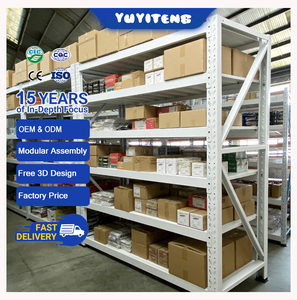
Selective Pallet Racking 1,000 – 4,500 kg / level 40% – 50% 100% Direct Access 3PL Logistics, Retail FMCG (Casablanca, Bouskoura) Standard to High-Ductility Frames
Drive-In Racking 1,000 – 1,500 kg / pallet 75% – 85% Low (LIFO / FILO) Cold Storage, Citrus & Vegetable Export (Agadir, Gharb) Requires Top Tie & Rear Portal Bracing
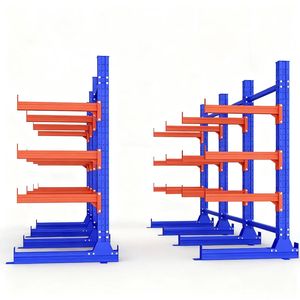
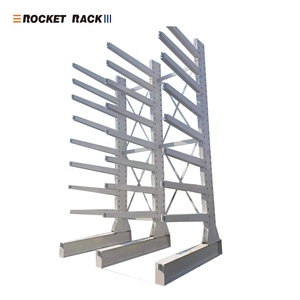
Heavy Duty Cantilever 500 – 2,000 kg / arm Variable (Open run) 100% for long items Steel tubes, PVC profiles, Timber (Tangier, Kenitra) Heavy I-Beam base plates anchored
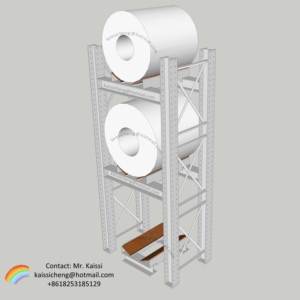
Steel Coil Storage Racks 5,000 – 25,000 kg / cradle 85% (High Mass) Tier-by-Tier Access Automotive Stamping Plants (Tanger Automotive City) Reinforced solid steel floor plates
Mezzanine Platforms 300 – 1,000 kg / m² 200% (Vertical Multiplier) Floor Level Access Textile workshops, E-commerce picking (Midparc, Rabat) Structural column cross-bracing
End-to-End Export Execution

From CAD Design to Turnkey Handover in Morocco

Procuring heavy industrial racking from an international manufacturer requires systematic coordination across engineering, fabrication, shipping logistics, and site commissioning.

01

Site Survey & CAD Layout

We analyze architectural drawings, column grids, clear ceiling heights under sprinkler mains, forklift turn radii, and concrete slab specifications.

02

Static & Dynamic Modeling

Structural calculation of beam deflection, frame loads, and seismic forces according to FEM 10.2.02 and Moroccan RPS 2000 seismic guidelines.

03

CNC Roll-Forming & Coating

High-precision automated cold-forming lines punch uprights with 50mm/75mm hole pitches, followed by automated shot blasting and powder coating.

04

Containerization to Morocco

Container optimization in 40ft HQ dry containers with heavy-gauge steel strapping, edge protectors, and rust-inhibiting wrapping directly to Tanger Med or Casablanca.

05

Installation Supervision & Signs

Complete erection guidance, precision leveling, torque-verified anchoring, and statutory safety load plaques installed on every single bay.

Manufacturing Excellence

Engineering Advantages Behind Every Rack We Deliver

Calculated Structural Safety

We do not use catalog approximations. Every warehouse racking bay is calculated based on exact pallet weights, dynamic forklift impact loadings, seismic zoning factors, and concrete slab tensile capacities.

Bespoke Architectural CAD & 3D Modeling

Our engineers provide complete 2D warehouse layouts and 3D isometric BIM models. We optimize aisle widths down to the millimeter, matching your counterbalance, reach, or VNA turret trucks.

Direct Port Deliveries to Morocco

Full logistics handling under CIF or DDP terms. We handle sea freight to Tanger Med Port, Casablanca Commercial Port, and Agadir, ensuring customs documentation conforms to Moroccan import regulations.

Procurement Knowledge Base

Frequently Asked Questions by Moroccan Warehouse Managers

Essential guidance addressing technical specifications, logistics, import clearances, and local building safety compliance in Morocco.

What documentation is required to clear steel racking into Morocco?

Imports into Moroccan ports (such as Tanger Med or Port de Casablanca) fall under the regulatory authority of the Administration des Douanes et Impôts Indirects (ADII). We provide full commercial invoices, packing lists with detailed steel net weights, Certificates of Origin, and Mill Test Certificates (MTC 3.1 according to EN 10204) certifying mechanical yield strength and chemical composition. For projects in Free Zones (Tanger Free Zone, Atlantic Free Zone), transit under customs bond (D19) is supported.

How do you calculate seismic resistance for warehouses in Northern Morocco?

Northern Morocco (Tanger-Tétouan, Al Hoceïma, Nador) is classified as a high seismic risk area under RPS 2000. We evaluate the building's ground acceleration coefficients and soil classification (S1 to S4). Racking structures are designed with thicker upright cross-sections, doubled anchoring per baseplate, heavy diagonal cross-bracings on the rear bays, and beam safety pins rated against vertical accelerations during an earthquake event.

Can your pallet racks integrate with European standard EURO-pallets and industrial pallets?

Yes. Moroccan facilities routinely handle both standard EUR / EPAL pallets (800 mm × 1,200 mm) common in trade with Spain and France, as well as ISO / Industrial pallets (1,000 mm × 1,200 mm). Our beam lengths (typically 2,700 mm for three EUR-pallets or 3,600 mm for four) and frame depths (usually 1,000 mm or 1,100 mm) are custom designed with pallet support bars and wire mesh decking to accommodate mixed pallet inventories safely.

What floor slab specifications are needed for heavy-duty racking?

For industrial selective racking with bay loads exceeding 10,000 kg, we generally recommend a reinforced concrete floor slab with a minimum thickness of 180–220 mm and a compressive strength of at least C20/25 or C25/30. The concrete must be capable of receiving M12 to M16 mechanical or chemical wedge expansion anchors with an embedment depth of 80 to 120 mm without spalling or punch shear failure.

What finish is recommended for outdoor yards or refrigerated warehouses in Morocco?

For agricultural cold stores in Agadir or unconditioned coastal yards in Casablanca, electrostatic powder coating alone may be vulnerable to high condensation or oceanic salt spray. For these aggressive environments, we provide hot-dip galvanized uprights and galvanized step beams, or a dual-layer epoxy-polyester powder coat system exceeding 100 microns DFT, tested up to 1,000 hours of neutral salt spray according to ASTM B117.

What is the typical maritime transit time to Tanger Med and Casablanca?

Our manufacturing lead time for standard project sizes (500 to 5,000 pallet positions) is typically 18 to 25 business days. Maritime transit from international manufacturing ports to Tanger Med Port averages 20 to 28 days, and approximately 25 to 32 days to Port de Casablanca. Containerized shipments are packed with custom timber dunnage and heavy-duty steel bands to prevent transit vibration damage.

Do you provide installation services or on-site supervision in Morocco?

We supply fully itemized, color-coded installation CAD drawings, assembly sequence blueprints, and torque specifications for every bolt and anchor. For major warehouse installations, we can dispatch bilingual (French/English) lead commissioning engineers to supervise local installation crews, verify plumbness tolerances according to EN 15635, and certify final load ratings prior to operational sign-off.

How does beam load deflection testing correlate with warehouse safety audits?

Under European standard EN 15512 and FEM 10.2.02, beam deflection under maximum working capacity is monitored closely. When our beams are loaded to 100% capacity (e.g., 3,000 kg per beam level), the maximum sag must not exceed 1/200th of the span distance (13.5 mm on a 2,700 mm beam). This strict safety margin ensures that insurance safety audits and Moroccan workplace safety inspectors validate your racking without operational restrictions.

Plan Your Moroccan Warehouse Racking Project with Storage Engineers

Whether fitting out a greenfield manufacturing plant in Tangier Automotive City, configuring high-density citrus storage in Agadir, or modernizing an e-commerce distribution hub in Casablanca, our engineering team provides free preliminary layout calculations, capacity plans, and formal quotations.