Specialized Production Capabilities
Export-Grade Industrial Storage & Heavy Warehouse Systems
Manufactured under strict ISO 9001 quality supervision, engineered to accommodate diverse intralogistics payloads, automated handling units, and extreme loading scenarios.
Technical Engineering Analysis
Why Double Deep Pallet Racking Dominates Indonesian Warehousing
A technical evaluation on operational footprint optimization, floor area utilization ratios, and seismic structural requirements for modern supply chain infrastructure.
Density vs. Selectivity Equilibrium
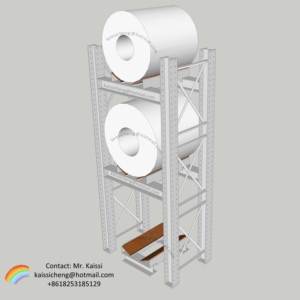
By placing two pallet positions back-to-back in 4-deep aisle bays, Double Deep racking eliminates up to 45% of unnecessary transit aisles compared to standard selective racking. This design delivers 50% immediate pallet selectivity while expanding gross storage density by up to 30-35%. Combined with pantograph or telescopic fork reach trucks, facilities achieve prime consolidation without sacrificing SKU turnover rate.
Seismic Ductility & SNI Calibration
Indonesia's geographical location along the Pacific Ring of Fire requires stringent seismic bracing calculations. Our factories engineer upright profiles using high-tensile Q235B and Q355B cold-rolled steel, calibrated against SNI 1726 and FEM 10.2.02 international guidelines. Uprights feature continuous omega profiles with high torsional rigidity, extra heavy baseplates, and ductile anchoring systems resistant to seismic shearing.
High-Humidity Surface Treatments
Tropical maritime environments across Jakarta, Surabaya, and Medan expose metal warehouse assets to accelerated oxidation. Our production lines integrate a 7-stage chemical immersion pre-treatment bath, nano-ceramic conversion coating, and high-polymer thermosetting epoxy polyester powder coating applied at 180-200°C. This delivers ASTM B117 salt spray corrosion resistance exceeding 500 hours.
Macro Logistics Intelligence
Indonesian Industrial Expansion & Racking Demand Trends
Market forces driving automated and semi-dense racking adoption across Java, Sumatra, and the upcoming Nusantara logistics corridor.
40%+
Industrial Land Cost Surge
32.8%
Cold Chain Logistics CAGR
1,200kg
Standard FMCG Pallet Load
11.5m
Average Modern Clear Height
Bekasi, Cikarang & Karawang Hubs
As Grade-A logistics space lease rates climb across Greater Jakarta (Jabodetabek), third-party logistics (3PL) operators and automotive assembly distributors cannot afford wide aisle waste. Double Deep setups provide the optimal consolidation bridge between low-density selective racks and costly fully automated ASRS systems.
Halal Cold-Chain & Food Hubs
With aggressive investment in frozen food, pharmaceutical storage, and fresh fisheries in East Java and North Sumatra, thermal storage efficiency is critical. Every cubic meter cooled incurs ongoing power expenses. Double Deep racking minimizes open cold volume, dramatically reducing electrical operational expenditures per pallet position.
Omnichannel E-Commerce Scalability
Indonesia's booming social commerce logistics platforms demand tiered fulfillment configurations. Double Deep arrays often serve as replenishment storage directly above ground-level high-velocity manual picking tunnels, balancing mass holding capacity with picking speed.
Manufacturing Excellence
Engineering Discipline & Direct Factory Assurance
Built upon proven load testing methods, certified CNC profiling facilities, and comprehensive structural warranty protocols.
01 / STRUCTURAL METROLOGY
FEM 10.2.02 Precision
Uprights, box beams, and step beams are load-tested and engineered against international FEM, RMI, and EN 15512 specifications. Automated continuous cold-forming guarantees sub-millimeter tolerances on all slot pitches.
02 / EXPORT INTEGRITY
Fumigated & Protected Bundling
Beam and upright packs are banded with edge protectors, waterproof plastic wrapping, and steel skids. Every ocean container is braced to withstand ocean transit, avoiding maritime salt contamination and mechanical damage.
03 / APPLICATION CONSULTING
Turnkey CAD & Static Models
We do not guess warehouse loads. We map customer forklift models, turning radiuses, aisle clearances, sprinkler drop clearances, and concrete slab specifications into optimized DWG proposals complete with stress-strain simulations.
04 / PROJECT RELIABILITY
Complete On-Site Accessories
Each Double Deep shipment includes high-visibility column guards, heavy end-of-aisle crash barriers, seismic expansion anchor bolts, safety lock pins, and certified bay weight capacity load plaques for Indonesian inspections.
Procurement Reference
Frequently Asked Questions by Indonesian Warehouse Operators
Technical guidance covering reach trucks, slab engineering, import certifications, and structural maintenance.
What specialized forklift equipment is required for Double Deep systems?
Double Deep racking requires a reach truck fitted with either double-reach pantograph scissors or telescopic extending forks. Additionally, for operating heights above 7 meters (common in modern Cikarang and Surabaya distribution centres), mast-mounted wireless cameras and laser fork guidance are recommended to help operators align forks on the rear pallet bay safely.
Can Double Deep accommodate standard Indonesian wooden and plastic pallets?
Yes. Our systems are engineered to accommodate standard ISO pallet sizes, including the common Indonesian 1000mm × 1200mm, 1100mm × 1100mm, and Euro 800mm × 1200mm formats. Heavy-duty pallet support bars or zinc-coated wire mesh decks can be integrated to safely support bottom-deflection pallets and non-standard skids.
How do you handle import documentation, SNI standards, and customs clearance?
We provide full export documentation including Certified Certificates of Origin (Form E for duty concessions under ACFTA), mill test certificates, packing lists, and certified structural load data. We coordinate directly with local Indonesian forwarders at Tanjung Priok (Jakarta) or Tanjung Perak (Surabaya) ports to ensure rapid release without costly demurrage.
What concrete slab floor strength is required for high-bay Double Deep installations?
Because Double Deep racking concentrates heavier vertical footings on fewer upright frames than wide-aisle systems, concrete slabs must generally withstand a minimum point load of 45 to 65 kN per baseplate, with a flatness tolerance adhering to DIN 18202 or TR34 FM2 specifications. Our structural team provides exact point-load calculations so your civil engineer can verify subsoil and rebar suitability.
Ready to Engineer Your Indonesian Storage Project?
Send your warehouse architectural CAD plan or target pallet counts to our engineering team. We deliver custom layout proposals, capacity calculations, and sea-freight quotation estimates within 24 hours.