High-Throughput Heavy Duty Storage & Material Handling Modules
Precision-fabricated industrial racking configurations engineered for dynamic pallet throughput, high unit loads, and extreme logistical durability across worldwide supply chains.
1. The Kinetic Architecture of Live Pallet Flow Racking
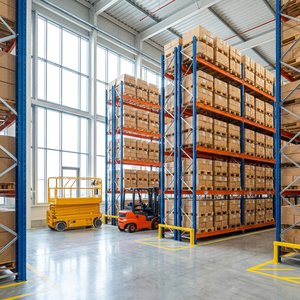
Live Pallet Racking, commonly designated in modern intralogistics engineering as Gravity Flow Pallet Racking or Dynamic Pallet Racking, operates on a high-density inclination methodology that transforms static storage volume into an autonomous, kinetic warehousing ecosystem. Driven exclusively by the deterministic laws of controlled gravity, live pallet storage systems decouple pallet input terminals from discharge terminals, thereby establishing a flawless First-In, First-Out (FIFO) stock rotation matrix. For multinational supply chain operators, distribution centers handling high-velocity Fast-Moving Consumer Goods (FMCG), pharmaceuticals, and multi-temperature cold storage environments, live pallet racking eliminates wasteful internal transit corridors while maximizing cubic volumetric storage efficiency up to 65% over traditional selective bay installations.
As premier Chinese structural manufacturers and global exporters, our engineering teams build beyond standard catalogue tolerances. We calibrate dynamic flow lanes through exhaustive finite element calculations, strictly conforming to the European FEM 10.2.02 (Design of Static Steel Pallet Racking), EN 15512 (Steel Static Storage Systems: Adjustable Pallet Racking Systems - Principles for Structural Design), and the American RMI MH16.1 structural standards. Each lane is treated as an integrated kinetic corridor, balancing roller friction coefficients, kinetic inertia, dynamic braking absorption, and mechanical pallet separation.
Gravitational Gradient Calibration
Flow beds are positioned at a measured inclination gradient precisely between 3.0% and 4.0% (nominally 3.5% or roughly 2 degrees). This gradient produces continuous forward gravitational drift while preventing free-fall structural runaways or premature mid-lane coasting stalls.
Centrifugal Speed Controllers
To eliminate kinetic acceleration risks over deep runs (up to 20+ pallets deep), self-actuating centrifugal brake rollers are integrated along the track. These mechanical brake units limit terminal pallet travel speeds to a safe, constant maximum velocity of 0.25 to 0.30 meters per second.
Mechanical Pallet Separators
A mission-critical safety feature, the mechanical front separator system isolates the lead pallet from the hydrostatic back-pressure exerted by accumulated pallets behind it. Once the forklift lifts the lead pallet, the secondary line advances safely without pinning the operator or mast.
Dynamic Roller Bed Geometries & Load Distributions
The core of live pallet racking reliability lies in roller metallurgy and precision bearing selection. Unlike light-duty gravity conveyors, heavy-duty industrial pallet flow beds bear unit loads spanning 500 kg to beyond 2,000 kg per pallet position. Rollers are engineered from heavy-gauge galvanized structural steel tubes (diameters typically Ø50mm to Ø60mm with wall thicknesses varying between 1.5mm and 2.5mm) mounted on spring-loaded hexagon axles with dust-proof, grease-packed precision ball bearings. Depending on whether bottom-deck wooden skids, 9-block Euro pallets (1200x800mm), industrial GMA pallets (48x40-inch), or plastic runner skids are conveyed, tracks are laid out in dual-lane, triple-lane, or full-width roller bed layouts. Continuous roller contact eliminates skid deflection and prevents point-load stress fracturing.
2. High-Density Intralogistics: Systematic Comparative Matrix
Logistics directors and procurement engineers evaluate dynamic gravity storage against selective, drive-in, and automated radio shuttle systems to pinpoint total cost of ownership (TCO) and operational throughput efficiency. The matrix below demonstrates the structural, operational, and financial trade-offs validated by our global installation data.
| Racking Topology | Volumetric Density | Stock Rotation Strategy | Aisle Requirements | Throughput Speed | MHE Impact Vulnerability | Structural Maintenance TCO |
|---|---|---|---|---|---|---|
| Live Pallet Racking (Gravity Flow) | Very High (85%) | Strict FIFO | Dual Aisle (Load & Pick) | Rapid (Zero waiting time) | Minimal (External bays only) | Low (Purely mechanical kinetic) |
| Standard Selective Racking | Low (40-45%) | Unrestricted Access | Aisle every double-run | High per SKU, Low density | Moderate (Frequent turning) | Negligible |
| Drive-In / Drive-Through | High (70-75%) | LIFO (FILO) typically | Single loading access | Sluggish (Driver enters bay) | High (Frequent upright strikes) | Moderate-High (Structural repairs) |
| Radio Shuttle System | Extreme (90%) | Programmable FIFO / LIFO | Configurable Dual/Single | Moderate (Shuttle transit time) | Very Low | High (Battery, sensors, shuttles) |
As illustrated, while automated radio shuttle systems offer exceptional compact volume, they introduce electronic failure points, battery degradation, and sensor sensitivity in sub-zero cold stores. Live Pallet Racking delivers nearly identical space utilization while retaining a purely mechanical kinetic propulsion system that guarantees uptime under punishing 24/7 operating cycles.
3. 2025–2035 Procurement Trends: The Evolution of Dynamic Storage
The global warehousing procurement landscape is experiencing profound systemic shifts. Rising industrial real estate leases, skyrocketing warehouse energy overheads, and the rapid deployment of Autonomous Mobile Robots (AMRs) and Automated Guided Vehicles (AGVs) have rewritten the structural baseline for industrial live racking systems exported from China.
AGV & AMR Autonomous Infeed Precision
Human forklift operators are increasingly being complemented or superseded by counterbalanced automated guided vehicles. Pallet entry guides, flared alignment channels, and optical lane sensors are now integrated directly into live rack uprights, ensuring sub-millimeter pallet placement without roller collision or snagging.
Ultra-Dense Deep-Freeze Buffers
In -25°C to -30°C pharmaceutical and refrigerated food warehouses, chilled air circulation costs dominate operational expenditure. Live pallet flow maximizes thermal mass efficiency by condensing thousands of pallet positions into a unified cube, reducing conditioned cubic space refrigeration losses by up to 35%.
High-Tensile Bolted Frames & Lifecycle Relocation
Supply chain agility demands that structural systems survive logistics facility relocation. Forward-looking buyers now specify bolted high-tensile upright assemblies with hot-dip galvanized baseplates and high-yield Q355B cold-formed steel that allows seamless dismantling, re-profiling, and lane re-pitching as SKU profiles evolve.
Decarbonization, Low-VOC Coatings, and Steel Traceability
Global procurement teams across Europe, North America, and Australia now demand rigorous structural steel traceability. Export-bound live pallet systems from tier-1 Chinese manufacturers incorporate certified mill test certificates conforming to EN 10204 3.1 standards. Surface engineering has advanced from solvent-heavy paints to environmentally sustainable TGIC-free electrostatic epoxy-polyester powder coats cured at 200°C, offering salt-spray resistance exceeding 500 hours and superior scratch toughness during aggressive warehouse loading maneuvers.
4. Enterprise Engineering Rigor: Why Global Exporters Choose Us
Selecting an export partner for mission-critical industrial storage requires proven structural engineering competence, traceable metallurgical inputs, and certified manufacturing workflows. Our manufacturing operations combine German CNC roll-forming lines, automated robotic multi-axis welding cells, and dedicated pre-shipment structural trial installations to deliver turnkey peace of mind.
Finite Element Stress Simulation
Every dynamic flow rack bay undergoes rigorous 3D Finite Element Analysis (FEA) modeling beam deflection (designed to stricter than L/200 deflection limits), shear load capacity, torsional upright buckling, and seismic base shear dissipation in accordance with AS 4084 and FEM 10.2.02 codes.
High-Yield Grade Steel Selection
We source certified prime continuous-cast coils of Q235B and high-yield Q355B structural steel from top-tier Chinese state mills (such as Baosteel and Shougang). This material delivers superior tensile strength (470–630 MPa) and elongation performance, preventing brittle shear failures under seismic stress.
Precision Export Packaging
To eliminate shipping damage across deep-sea container transit, upright frames are nested with protective high-density polyethylene interleaving, beams are strapped in custom steel cradles, and roller beds are pre-assembled in calibrated sub-modules with desiccant protection against maritime condensation.
Turnkey CAD Layout Optimization & Structural Safety Accreditations
Our engineering support services initiate long before the raw steel enters the roll-forming dies. Clients receive end-to-end parametric CAD layouts, including forklift aisle turning sweep calculations, clear height optimization under overhead building obstacles, in-rack fire suppression sprinkler layout alignment, and floor slab point-load engineering reviews. Every project ships with permanent, high-contrast, laser-engraved steel load warning signage detailing maximum bay capacity, unit pallet ratings, roller incline calibration data, and annual inspection protocol certifications.
5. Authoritative Buyer FAQ: Engineering & Procurement Essentials
Direct technical responses addressing complex engineering parameters, operational fail-safes, and installation considerations for senior warehouse engineers and procurement officers.
What are the exact slab load-bearing and leveling requirements for high-density live pallet racking? +
How does the roller bed design accommodate damaged, warped, or non-standard wooden pallets? +
What prevents catastrophic pallet runaway if an internal brake roller fails? +
Can live pallet racking be effectively deployed in sub-zero cold storage environments? +
How are in-rack fire protection and sprinkler regulations addressed in deep-lane flow beds? +
What documentation and structural certification are supplied with export shipments? +
Accelerate Your Warehouse Intralogistics Efficiency
Connect directly with our structural engineering team to receive a complimentary custom CAD layout, beam deflection calculation, and competitive factory-direct export quote tailored to your warehouse pallet specifications.