Choosing the right Drive In Racking Systems begins with understanding your inventory, forklift patterns, and required storage density. Drive-in racks can remove multiple aisles and place pallets deep inside compact lanes. That advantage is powerful. It is not universal.
The MHI 2024 Annual Industry Report shows that warehouse operators continue investing in automation, digital visibility, and space efficiency. Grand View Research also identifies warehouse racking as a growing global market, driven by e-commerce and tighter facility footprints. These reports support a clear direction: storage systems must improve capacity without weakening safety or accessibility.
Warehouse consultant Jeffrey H. Karrenbauer offers a useful principle: “Storage density must serve the operation, not replace it.” His point matters when comparing Drive In Racking Systems with selective, push-back, or pallet-flow designs. A cold-storage facility holding large quantities of identical products may benefit from deep lanes and limited stock rotation. A distributor handling many stock-keeping units may lose time searching for pallets.
Picture a forklift entering a dark, narrow lane. Rail damage, poor load placement, or unclear travel rules can quickly reduce confidence. Rack protection, load guidance, inspections, and operator training deserve equal attention. OSHA’s warehouse guidance repeatedly emphasizes safe forklift operation and competent rack management.
The numbers help, but they cannot choose the system alone. Product turnover, pallet condition, ceiling height, fire protection, and future expansion also matter. A dense layout may look efficient on paper. In practice, it can become restrictive. The best decision combines measured data, site experience, and honest testing before installation.
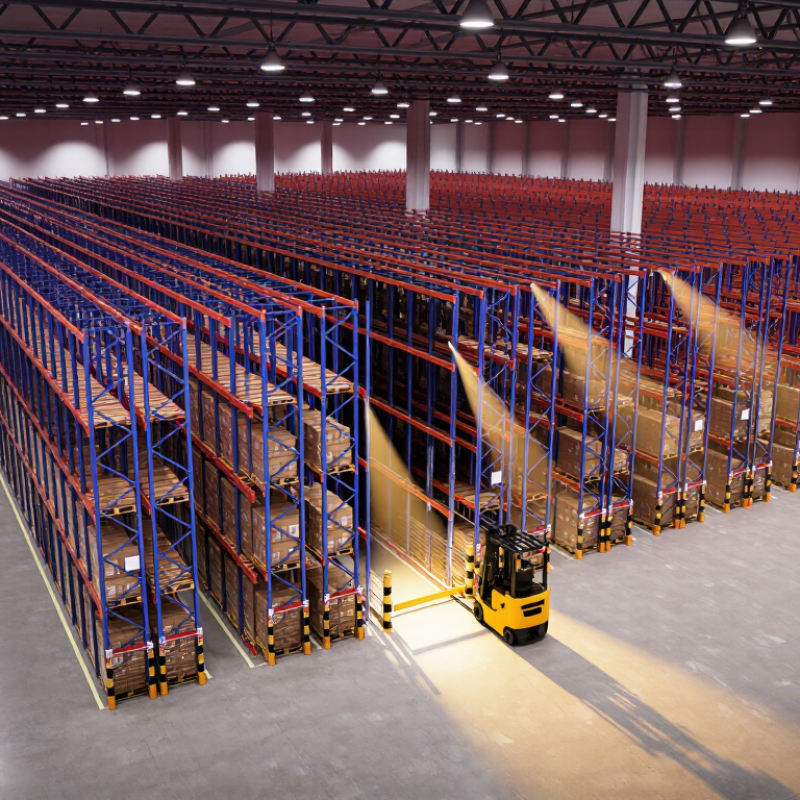
How to Choose the Best Drive-In Racking Systems?
Drive-in racking systems store pallets on deep rails, creating high-density lanes with fewer aisles. Forklifts enter the structure to load and retrieve pallets. This design suits warehouses holding large quantities of the same product. It works especially well for cold storage, seasonal goods, and inventory with limited SKU variety.
Drive-in racks usually follow a last-in, first-out pattern. The newest pallet enters first and may block older stock. That matters for products with expiry dates or strict rotation requirements. Check pallet dimensions, load weights, forklift clearance, and ceiling height before choosing a system. Rail spacing must support stable pallet placement without forcing operators into awkward movements. Small measurement errors can become expensive daily problems.
From warehouse assessments, I have found that density is not the only useful measure. Loading speed, product access, and operator visibility also affect performance. A drive-in system may save floor space but slow picking when every pallet is different. Safety depends on upright protection, rack inspections, clear operating rules, and trained forklift drivers. Independent engineering guidance and local safety requirements should inform the final layout. I once underestimated travel distance in a dense layout; the storage calculation looked excellent, but daily movement became tiring. That experience still shapes my recommendations. Test one lane with real pallets before approving the full installation.
Drive-in racking provides high-density storage for large quantities of similar pallets. It is especially suitable for LIFO inventory, limited SKU variety, and products that can remain stored for longer periods. The ratings below compare common pallet-racking applications on a practical 1–5 planning scale.
Rating guide: 1 = limited suitability, 5 = strong suitability. Drive-in racks prioritize storage density and LIFO operation over pallet selectivity and FIFO access.
Choosing the best drive-in racking system starts with the warehouse itself. Measure clear height, aisle width, column positions, doors, sprinklers, and floor condition. Do not trust old drawings. Walk the storage area with a tape measure and a forklift operator. A small obstruction can reduce usable capacity or create difficult loading movements.
Inventory characteristics matter just as much as available space. Drive-in storage suits large quantities of similar pallets with limited product variety. Check pallet dimensions, weights, stackability, and entry direction. Turnover matters. Fast-moving products may become inconvenient when newer pallets block older ones. If your team needs direct access to every pallet, a different configuration may be more practical.
Review daily operations before approving the layout. Record how many pallets arrive, how long they remain, and which products share storage lanes.
I have seen capacity calculations look excellent on paper, yet fail during busy shifts because forklifts needed extra turning room. That mistake is easy to repeat. Leave practical clearance, not only theoretical clearance.
Confirm rack load data, pallet condition, floor strength, and operator visibility with qualified professionals. Regular inspections should also reflect real damage, uneven loading, and changing inventory patterns. A system can be technically suitable today but unsuitable after seasonal stock increases. Recheck the assumptions.
Drive-in racking systems can store many pallets in a compact footprint, but density is only one design measure. In warehouse assessments, I look closely at lane depth, upright spacing, rail position, and forklift entry height. Deep lanes suit uniform products with limited variations. However, they can slow stock rotation and hide damaged pallets. A shorter lane may use more floor space but improve visibility and handling.
Load capacity requires more than adding pallet weights together. The design must account for beam loads, upright strength, pallet condition, forklift impact, and floor performance. Each level should match the actual pallet dimensions and load distribution. Uneven goods can create pressure points on support rails. Clearances also matter, especially when operators place pallets at upper levels. A small measurement error can affect the whole structure.
Access options should reflect the warehouse’s daily movement pattern. Single-entry lanes support last-in, first-out handling. Two-sided access can support better rotation but needs a suitable drive-through layout. Forklift turning space, aisle width, and operator visibility should be checked on site, not assumed from a drawing. I have seen layouts that looked efficient on paper but felt restrictive during loading. Adjustable guides and visible lane markings can help, though they do not replace regular inspections. The best choice may still require revision after observing real traffic, pallet damage, and loading habits.
Evaluating Safety Features, Durability, and Installation Needs
Safety should guide every drive-in racking decision. Inspect upright protectors, guide rails, pallet stops, and visible load ratings. These features reduce impact damage and prevent unstable pallet placement. Confirm that forklift dimensions match the entry lanes. A few extra centimeters can prevent costly contact. Keep emergency access and inspection paths clear. Never treat a warning sign as decoration.
Durability depends on more than thick steel. Examine weld quality, frame alignment, bracing, and corrosion resistance. Cold storage, humidity, and frequent forklift traffic create different stresses. Ask for verified load testing and material specifications. In warehouse inspections, small bends often reveal repeated impacts. They deserve immediate attention. A perfect-looking surface may hide weakened connections. No checklist is perfect.
Installation needs careful site preparation. Measure floor flatness, ceiling height, aisle width, and column spacing before delivery. The floor must support the loaded structure, not just the empty rack. Qualified installers should anchor frames, check vertical alignment, and verify every connection. Commissioning should include a controlled loading test. Rushing this stage creates avoidable risks. I would also leave room for future maintenance, even when space feels limited. That decision is easy to regret later.
Selecting the right drive-in racking system starts with your warehouse’s daily workflow. Drive-in storage suits uniform pallets, high volumes, and fewer product variations. It usually supports last-in, first-out inventory movement. If stock rotation matters, a drive-through layout may be more suitable.
Measure pallet height, width, weight, and base condition carefully. Then check forklift turning space, mast clearance, and aisle access. A small measurement error can reduce usable capacity or create unsafe contact with rails. Ask a qualified storage engineer to review the layout, load data, floor strength, and local safety requirements. Real operating conditions matter more than a perfect drawing.
Tips: Test one rack lane with your actual forklift and pallets. Watch entry speed, visibility, and driver comfort. Keep damaged pallets out of deep lanes. Inspect upright frames, guide rails, and load supports regularly. Do not assume every pallet is identical; moisture, repairs, and uneven loads can change stability. A trial may expose problems early, although it may also slow the project. That inconvenience is useful. Recheck inventory rotation before approving the final design.
| Selection Dimension | Typical Drive-In Configuration | Typical Drive-Through Configuration | What to Check Before Selecting | Priority |
|---|---|---|---|---|
| Inventory rotation | Last-in, first-out (LIFO). Suitable when strict first-in, first-out rotation is not required. | First-in, first-out (FIFO) is possible because forklifts can load from one side and unload from the opposite side. | Confirm product shelf life, expiration controls, batch-tracking procedures, and customer requirements. | Critical |
| Number of stock-keeping units (SKUs) | Most effective when each lane stores one SKU or one homogeneous product group. | Also best for dedicated lanes with consistent product dimensions and handling requirements. | Compare the number of pallets per SKU with the required number of accessible lanes. | Critical |
| Pallet quantity per SKU | Generally more suitable for several pallets of the same SKU stored in deep lanes. | Works well when pallet quantities justify access from both ends of the lane. | Measure average and peak pallets per SKU. Low quantities may leave lane space unused. | High |
| Storage density | High pallet density because storage lanes reduce the number of aisles required. | High density, but both lane ends require operational access and aisle space. | Compare usable pallet positions after allowing for drive aisles, fire protection, columns, and pedestrian routes. | High |
| Forklift access | The forklift enters the storage lane, so the truck must be suitable for the available lane width and height. | The forklift can enter from either end, but the layout must support safe two-sided traffic planning. | Verify forklift width, turning radius, lift height, mast dimensions, load length, and operator visibility. | Critical |
| Recommended lane depth | Commonly designed for multiple pallet positions in depth; the exact depth depends on pallet size, load clearances, and equipment. | Lane depth must support loading and unloading from opposite ends without obstructing the structure. | Use verified pallet dimensions and add engineering clearances; do not select depth from nominal pallet size alone. | Critical |
| Pallet condition | Requires pallets with consistent dimensions and sufficient strength for the supported load. | Requires consistent pallets because loads are handled from both ends and may experience repeated movements. | Inspect pallet quality, bottom-board layout, load distribution, and compatibility with support rails. | Critical |
| Load characteristics | Best for stable, unitized loads with consistent weight and dimensions throughout a lane. | Best for stable loads that can tolerate handling from both sides without product damage. | Confirm maximum pallet weight, center of gravity, overhang, packaging stability, and load containment needs. | Critical |
| Operating frequency | Suitable for lower- to moderate-frequency access where maximum selectivity is not required. | Suitable when regular loading and unloading activity benefits from separate entry and exit sides. | Review pallet movements per hour, peak-season volume, congestion, and required service levels. | Medium |
| Temperature-controlled storage | Often considered for cold rooms because dense storage can reduce the volume that must be temperature controlled. | Can be used in cold rooms when FIFO handling and access from both sides are operational requirements. | Check corrosion protection, floor condition, condensation, freezer-suitable equipment, and emergency access. | Medium |
| Safety and compliance | Requires impact protection, rack protection, load notices, controlled driving practices, and regular inspections. | Requires the same controls, plus clear traffic separation and safe coordination at both lane entrances. | Obtain a site-specific design from a qualified engineer and follow applicable local building, fire, and workplace-safety rules. | Critical |
| Best-fit warehouse profile | High-volume storage of relatively few product types, with strong emphasis on space utilization. | High-volume storage requiring FIFO rotation, two-sided access, and organized product flow. | Choose drive-in for density and LIFO simplicity; choose drive-through when FIFO and two-sided flow justify the additional access space. | High |
It suits warehouses storing many uniform pallets with few product variations. Cold storage and seasonal goods are common examples. Density matters. So does access.
Most systems use last-in, first-out movement. The newest pallet enters first and can block older stock. This may not suit dated products. Check rotation needs carefully.
Measure pallet height, width, weight, and base condition. Check forklift clearance, aisle width, ceiling height, and column spacing. Small errors create daily problems.
Inspect upright protectors, guide rails, pallet stops, and visible load ratings. Keep emergency paths clear. Warning signs are operational tools, not decoration.
Review frame alignment, bracing, weld quality, and corrosion resistance. Frequent forklift impacts can bend hidden connections. A clean surface proves little.
The floor must support the fully loaded structure. Qualified installers should anchor frames and check vertical alignment. Include controlled loading tests during commissioning.
No. It can save floor space but slow picking when pallets differ frequently. Forklift travel distance also affects fatigue. I once underestimated this issue.
Test one lane using real pallets and the actual forklift. Watch entry speed, visibility, turning space, and driver comfort. A trial may delay approval. That delay can reveal expensive flaws.
Choosing the right Drive In Racking Systems requires a clear understanding of how your warehouse operates and what types of products you store. These systems are designed for high-density storage, making them especially suitable for large quantities of similar, palletized goods. Before making a decision, assess your available space, ceiling height, inventory turnover, pallet dimensions, and the level of accessibility required. A careful review of these factors will help determine whether a drive-in configuration is appropriate for your storage strategy.
It is also important to compare rack layouts, load capacities, entry and exit options, and compatibility with material-handling equipment. Safety features, structural durability, protective components, and installation requirements should be evaluated to support reliable long-term performance. Consider how easily the system can be maintained, expanded, or adapted as your warehouse needs change. By balancing storage density, product access, safety, and operational efficiency, you can select a Drive In Racking Systems solution that makes the best use of your facility while supporting organized and dependable warehouse operations.