Double Deep Pallet Racking is a high-density storage system designed to place two pallets deep within each rack position. It uses specialized double-deep reach trucks to access the rear pallet. This arrangement can increase warehouse capacity without expanding the building footprint. However, it is not simply standard racking with extra depth. Equipment choice, pallet condition, aisle width, and operator skill all affect performance.
The system usually places two pallet positions behind one another, front to back. The first pallet enters the rack, while the second pallet moves beyond it. During retrieval, the front pallet must normally be removed before the rear pallet can be reached. This creates a last-in, first-out tendency for some stored products. Warehouses handling similar products in full-pallet quantities may benefit most. Fast-moving or highly varied inventory may require a different design.
Details matter. Upright frames, load beams, guide rails, and truck reach must work together accurately. Floor flatness also matters more than many planning teams expect. A small alignment problem can become a daily handling problem. Safety checks should confirm load ratings, pallet quality, rack protection, and operating clearances. Qualified rack designers and equipment suppliers should verify the layout before installation.
This guide explains how Double Deep Pallet Racking works, where it performs well, and where its limitations appear. It also examines storage density, accessibility, equipment requirements, safety practices, and operating costs. Some warehouse estimates look excellent on paper. Real traffic patterns may tell a different story. Careful measurement remains essential.
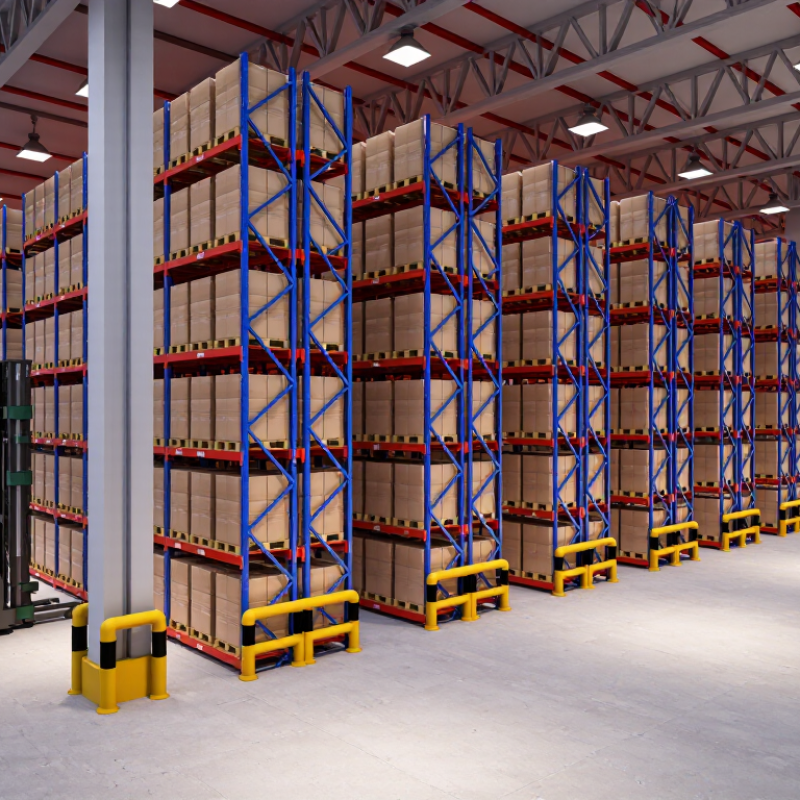
Double-deep pallet racking stores two pallets behind one another in a single rack position. This arrangement increases storage density without expanding the warehouse footprint. A forklift places the first pallet at the rear, then positions the second pallet in front. Access follows the LIFO principle: last in, first out.
The front pallet must be removed before workers can reach the rear pallet. This makes double-deep racking suitable for products with stable demand, long shelf lives, or limited stock rotation requirements. For example, a forklift may load canned goods into the rear position on Monday and place another pallet in front on Tuesday. The Tuesday pallet leaves first.
Clear operating rules matter. Forklift drivers need enough reach and lifting accuracy to avoid striking the rear pallet or rack frame. Rack aisles also require careful measurement, since deeper storage can influence turning space and visibility. Load weight, pallet condition, and beam capacity should be checked by a qualified storage professional.
The system is efficient, but not perfect. It can slow access when a rear pallet is urgently needed. Some warehouses also discover that poor labeling creates avoidable searching time. Regular inspections, accurate location records, and consistent loading practices help control these weaknesses. Space savings alone do not guarantee better performance.
Double deep pallet racking stores two pallets behind one another, reducing the number of aisles required.
A practical layout starts with parallel rack rows placed back-to-back. Each row faces a working aisle, while the shared rack structure separates the opposite storage positions. The map should show rack length, aisle width, column locations, and emergency access paths.
Each storage bay holds two pallets in depth.
The front pallet is handled first, while the rear pallet remains temporarily blocked. This arrangement suits warehouses storing several pallets of the same product. It works best when inventory moves in planned batches. A reach truck with extended forks or a pantograph mechanism must enter the aisle safely. Small measurement errors can create expensive handling problems.
Aisles need enough clearance for turning, lifting, and positioning loads without striking uprights. Operators should mark floor lines and test the route with a loaded truck before final installation. Keep rack labels visible from the aisle. Also, confirm pallet dimensions, load weights, and beam capacities with a qualified rack professional. Space matters. So does visibility.
Double deep storage can increase pallet positions, but it may reduce direct access to individual loads. A layout that looks efficient on paper may slow picking during urgent orders. I would review movement history before choosing this system. If products change frequently, the second position may become inconvenient. In real warehouses, flexibility often matters more than maximum density.
Double-deep pallet racking stores two pallets behind one another in each lane. This layout can increase pallet positions without expanding the building footprint. Industry guidance often cites gains of roughly 30 percent over single-deep layouts. However, results depend on aisle width, pallet sizes, and fire clearances. I would not treat 30 percent as universal.
A reach truck handles the critical movement. The operator enters the lane and retrieves the front pallet first. The truck’s extending mechanism supports the load, then withdraws it into the aisle. If the rear pallet is needed, the front pallet must be removed and staged temporarily. Only then can the truck reach the second position. It is slower than selective racking. That trade-off matters.
Clear labels and disciplined slotting reduce unnecessary reshuffling. Pallets should remain square, stable, and within the rack’s rated capacity. OSHA’s powered industrial truck rule, 29 CFR 1910.178, requires operator training and performance evaluation at least every three years. MHI’s 2024 Annual Industry Report states that 83 percent of respondents expect supply chains to become more digitally connected within five years. That trend supports barcode checks and inventory visibility, not careless speed. A reach truck can make the first retrieval look simple. It is not. Uneven floors, damaged pallets, or poor slotting can erase the expected productivity gain.
In double-deep pallet racking, two pallets are stored one behind the other. A reach truck normally retrieves the front pallet first. After the front position is clear, the truck can extend its reach mechanism to access and retrieve the rear pallet.
Double-deep pallet racking stores two pallets behind one another in each rack position. A suitable reach truck places the first pallet at the rear, then positions another pallet in front. This arrangement reduces the number of aisles needed. It can create up to 30% more storage capacity than single-deep racks.
The gain depends on warehouse dimensions, pallet sizes, rack heights, and forklift clearance. It also depends on inventory movement. Double-deep storage works best when several pallets contain the same product. However, rear pallets are less accessible. This can slow picking and complicate first-in, first-out rotation.
A 30% increase is possible, not guaranteed. In some warehouses, the real improvement may be lower because of columns, fire clearances, or uneven floor space. That detail is easy to overlook.
Tips: Measure every aisle, pallet, and turning area before planning. Confirm load ratings with a qualified rack engineer. Leave enough clearance for the truck mast and rear pallet placement. Label front and rear positions clearly. Test the layout with an experienced operator, because drawings rarely show every practical problem. A second measurement is worthwhile.
Double deep pallet racking stores two pallets behind each other in one lane. A specialized forklift places the rear pallet first, then loads the front position. During retrieval, the front pallet must move before the rear pallet becomes accessible. This design increases storage density and reduces aisle requirements. However, it also creates a clear trade-off: access becomes less immediate.
The strongest use case is a warehouse handling high volumes of a limited number of SKUs. Beverage cases, packaged materials, and seasonal bulk goods often fit this profile. Each lane should hold identical products, with predictable rotation and stable pallet dimensions. A facility with thousands of low-volume SKUs may lose efficiency quickly. Too many product changes can create reshuffling, extra travel, and hidden labor costs.
The numbers support careful selection. MHI’s 2024 Annual Industry Report found that 55% of respondents planned to increase supply-chain technology investment. Yet denser storage alone does not solve operational problems. WERC’s 2024 DC Measures report identifies inventory accuracy near 99% as a common benchmark, with leading operations approaching 99.9%. Double deep systems need disciplined scanning and location control to protect that performance. One missed pallet can block another. That is expensive.
Product rotation also matters. Double deep storage naturally favors last-in, first-out movement unless the layout and handling process are deliberately controlled. I would not specify it for every fast-moving product. Test travel time, pallet access, and replenishment frequency first. The extra capacity may look impressive, but the wrong SKU profile can quietly erase the gain.
It stores two pallets behind one another in the same lane. The front pallet must move before the rear pallet is reachable. This increases density but reduces direct access.
It suits high-volume warehouses with limited SKUs and repeated pallet loads. Packaged materials, beverages, and seasonal bulk goods may fit well. Variety creates friction.
Place parallel rack rows back-to-back, with working aisles on both sides. Mark rack length, aisle width, columns, and emergency access paths. Keep labels visible.
Use a reach truck with extended forks or a pantograph mechanism. The truck must enter, lift, and position loads without touching uprights. Small errors become costly.
Aisles need clearance for turning, lifting, and accurate positioning. Test the route with a loaded truck before installation. Paper measurements can mislead.
Confirm pallet dimensions, load weights, and beam capacities with a qualified rack professional. Two-deep storage depends on consistent pallet sizes. Mismatched loads cause trouble.
Not always. The front pallet blocks the rear pallet, which can delay urgent orders. Review movement history, replenishment frequency, and travel time before choosing it.
Use disciplined scanning and precise location control. One missed pallet can block another. Dense storage helps only when records remain reliable.
Double-deep storage naturally favors last-in, first-out movement. Controlled procedures may be needed for different rotation goals. I would test real movements before committing.
Choosing maximum density without checking flexibility. A layout may look efficient but create reshuffling and extra travel. I may be too cautious, but movement history deserves attention.
Double Deep Pallet Racking is a high-density storage system that places two pallets deep in each storage position. Unlike single-deep racks, it uses back-to-back rows with aisles positioned between them, allowing warehouses to store more inventory within the same floor area. Each bay is designed to hold two pallets in a straight line, making efficient use of available space.
Because access is based on a last-in, first-out (LIFO) arrangement, forklifts—often reach trucks—retrieve the front pallet before accessing the pallet behind it. This system can provide up to 30% more storage capacity than single-deep racking, depending on the warehouse layout and operating conditions. It is best suited to high-volume, low-SKU operations where multiple pallets of the same or similar products are stored and strict first-in, first-out rotation is not essential.